What you will be able to do after this lesson
You will break the camp down into subsystems and understand which data each of them requires.
Why it matters
A camp starts with a functional program: how many people live there at the same time, how they eat, where they wash, where they do laundry, who provides medical care, where the administration and security are located. Accommodation modules are only one of the subsystems, and often not the most complex one.
The subsystems are interrelated: the number of diners determines the canteen and its services, the number of residents determines the sanitary fixtures, and all of it together determines the power balance, water, wastewater and communications. If the buildings are calculated separately, the external networks will turn out to be undersized.
External networks, roads, lighting, security and paved areas also need defined boundaries of responsibility. It is convenient to separate the mandatory scope from options, but safety and regulatory requirements are not options.
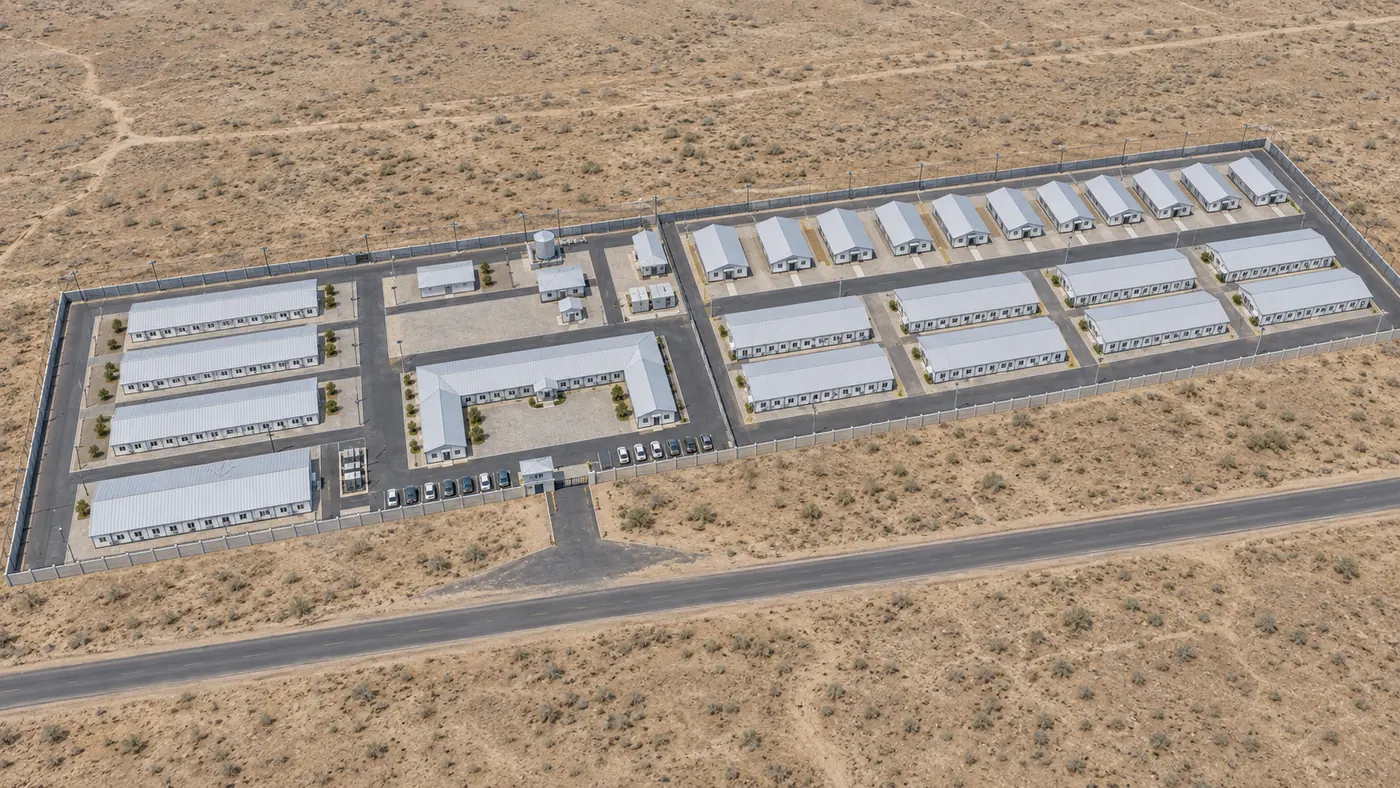
| Subsystem | What determines its composition | INTERMODULE page |
|---|---|---|
| Accommodation | number of simultaneous residents, categories, room area | Dormitories |
| Catering | number of diners, shifts, kitchen process | Canteens |
| Sanitation and amenities | fixtures per clause 10, laundry, drying room | Sanitary modules |
| Medical care | medical station functions, equipment | Medical modules |
| Management and security | workstations, communications, security checkpoint | Admin and welfare block (ABK), Security checkpoint |
| Building services | power balance, heat, water, wastewater, communications | Technological modules |
How to apply this on a project
- Step 1. Start with the functional program and the headcount.
- Step 2. Treat housing, catering, sanitary facilities, laundry, medical care and administration as interrelated subsystems.
- Step 3. Define the boundaries of responsibility for external networks, roads, lighting, security and paved areas.
- Step 4. Separate the mandatory baseline from options, but never classify safety and regulatory requirements as options.
Typical mistake
Counting the accommodation modules first and adding infrastructure at the end, with whatever is left over.
Check before the next step
- Accommodation buildings
- Catering
- Sanitation
- Laundry
- Medical care
- Administration
- Building services
- Logistics
Related materials and tools
- INTERMODULE shift worker camps
- Project: shift worker camp at the Prorva site
- 17 questions to answer before ordering a shift worker camp
Apply the lesson to your project
Gather the input data and record the unknown parameters as questions for approval. We prepare a calculation based on the questionnaire within 1 working day.