What you will be able to do after this lesson
You will read the INTERMODULE size range and know which sizes can be transported without a special permit.
Why it matters
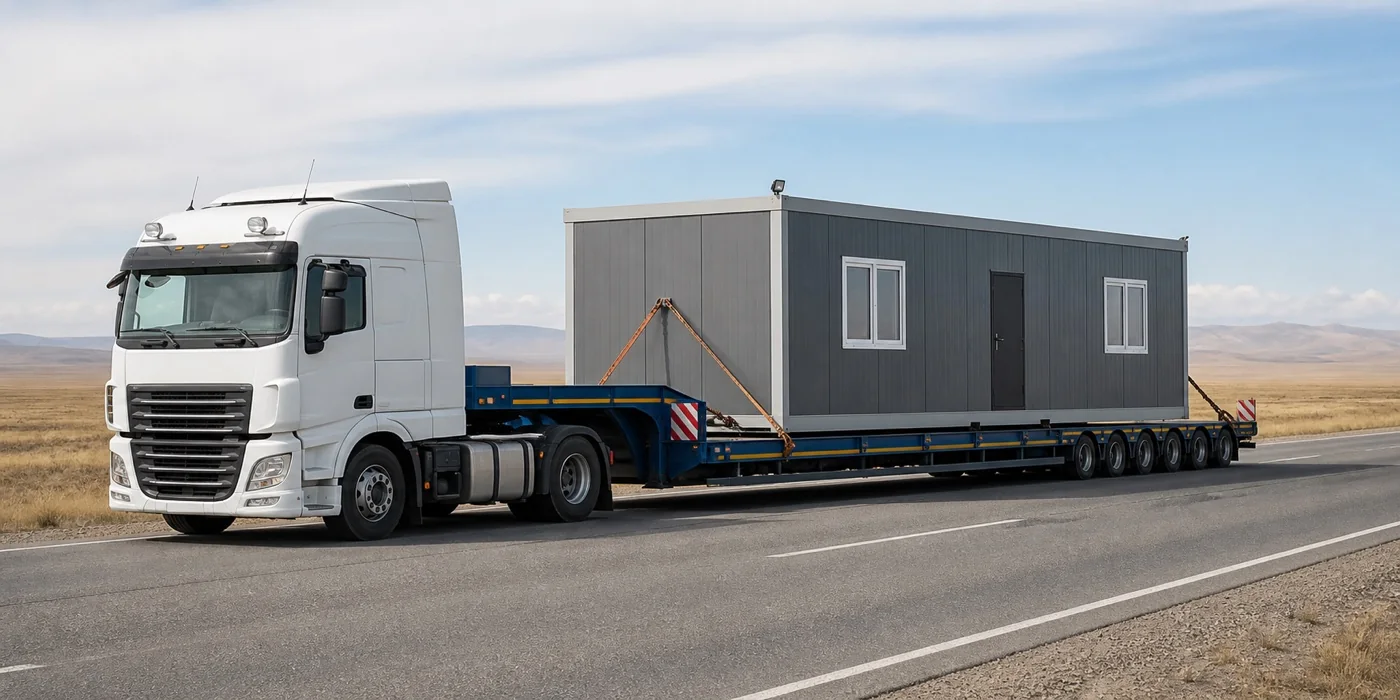
INTERMODULE uses two width families, 2 435 and 2 990 mm, and a fixed range of lengths. The 2 435 mm width fits within the 2 550 mm road limit and is transported without a special permit; 2 990 mm is already oversize, and its transport is costed separately. A corridor module can have its own width, including 2 000 mm.
The internal height is chosen from the range 2 340 / 2 540 / 2 700 / 3 000 mm; the external height starts from 2 600 mm. For module compatibility, not only length and width matter but also finished floor and ceiling levels: without them, a single building ends up with steps and differing ceilings.
The Academy does not propose one universal size for the entire market. Compatibility families are more practical: within a family, modules from different manufacturers join by geometry and levels.
| Parameter | Values | Note |
|---|---|---|
| Width | 2 435 or 2 990 mm | 2 435 mm travels on Kazakhstan roads without a special permit; anything wider than 2 550 mm is transported as oversize |
| Length | 2 435 / 4 885 / 6 055 / 7 335 / 12 000 mm | a fixed range, not a span; 12 m is based on a 40-foot body |
| External height | from 2 600 mm | depends on the chosen internal height and roof design |
| Internal height | 2 340 / 2 540 / 2 700 / 3 000 mm | from finished floor to finished ceiling |
| Corridor module | width 2 000 / 2 435 / 2 990 mm | the net passage width is verified against the design and evacuation requirements |
How to apply this on a project
- Step 1. Remember: INTERMODULE uses the 2 435 and 2 990 mm width families and a fixed range of lengths.
- Step 2. A corridor module can have its own external dimension, for example 2 000, 2 435 or 2 990 mm.
- Step 3. For compatibility, not only length and width matter but also finished floor and ceiling levels.
- Step 4. Verify the transport conditions for each dimension against the route and the design.
Typical mistake
Declaring any size "standard for transport" without checking the actual route and restrictions.
Check before the next step
- External length
- External width
- External height
- Clear height
- Floor level
- Corridor
- Route
Related materials and tools
Apply the lesson to your project
Gather the input data and record the unknown parameters as questions for approval. We prepare a calculation based on the questionnaire within 1 working day.