What you will be able to do after this lesson
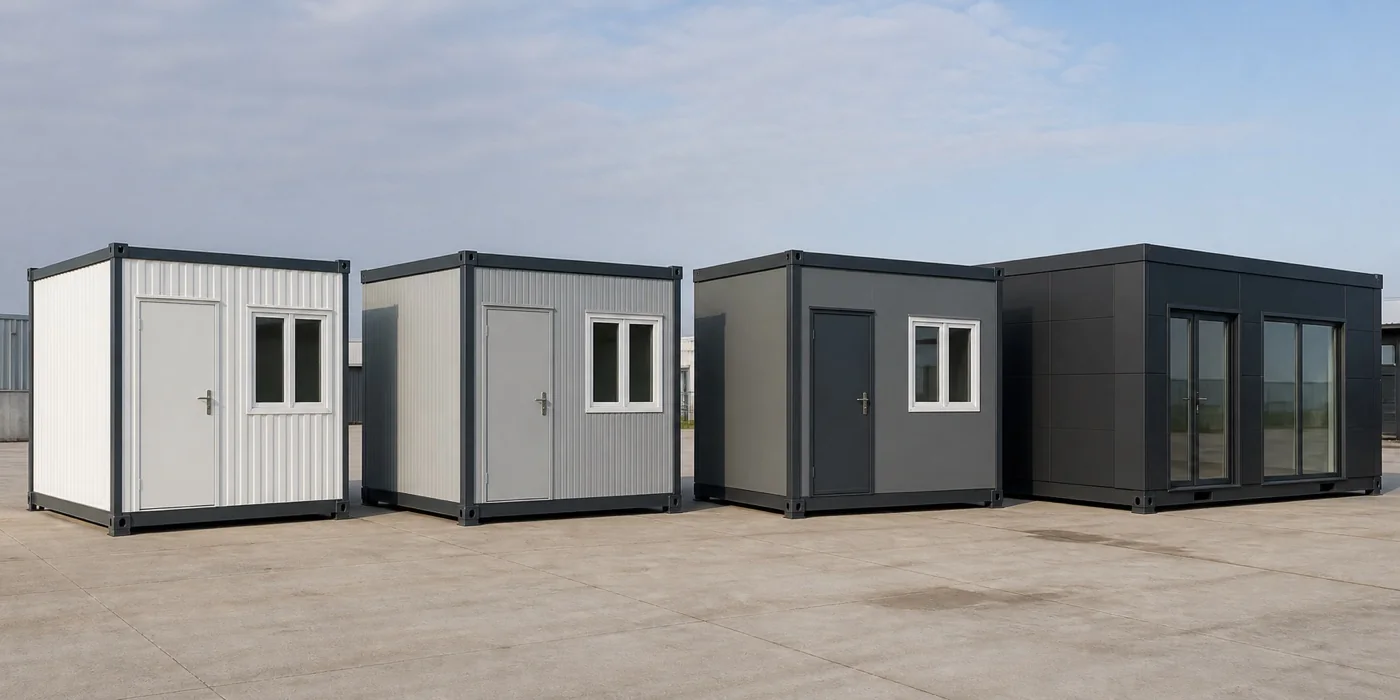
You will be able to distinguish series-built modules from the Project series and understand what exactly is worth unifying.
Why it matters
The series is the level of structure and fit-out: Budget, Standard or Project. The purpose — office, accommodation, sanitary — is an independent characteristic. Options — insulation, climate, equipment — are the third level. Mixing them in one list of "series" is not acceptable: proposals then become impossible to compare.
Standardization concerns interfaces: joint geometry, fixings, service entries, typical materials and fasteners, marking, acceptance. Architecture, facades and layouts remain free. The Academy's formula: standardize the interfaces, preserve architectural freedom.
A series build makes proposals comparable and reduces the client's dependence on a single factory. The Project series remains for cases where function, safety or site conditions genuinely require it.
| Parameter | Budget | Standard | Project |
|---|---|---|---|
| Frame | painted steel 2 mm | cold-formed galvanized profile 2,5 mm, hot-dip galvanized fittings | engineered for the loads in the specification |
| Walls | battens with mineral wool, OSB inside | three-layer sandwich panels with basalt core | per specification |
| Floor | OSB 18 mm | cement-bonded board 20 mm | per specification |
| Electrics | surface wiring | concealed wiring, LED lighting | per design |
| Storeys | 1 | up to 3 | per design |
| Transport | assembled, 2 modules per truck | knock-down, 4–8 modules per truck | per design |
How to apply this on a project
- Step 1. Unify interface geometry, fixings, service entries and typical materials.
- Step 2. Do not confuse standardization with identical architecture.
- Step 3. Use series builds to compare products; formalize special requirements in a design.
- Step 4. Open compatibility reduces the client's dependence on a single manufacturer.
Typical mistake
Creating a unique detail for every project without a technical reason.
Check before the next step
- Interfaces
- Materials
- Fasteners
- Service entries
- Tolerances
- Series variants
Related materials and tools
Apply the lesson to your project
Gather the input data and record the unknown parameters as questions for approval. We prepare a calculation based on the questionnaire within 1 working day.